The intelligence cycle
Iceberg follows the traditional intelligence cycle — direction, collection, analysis, production, dissemination, feedback — with a screen for each phase and traceability across all of them.
Direction: requirements and tasking
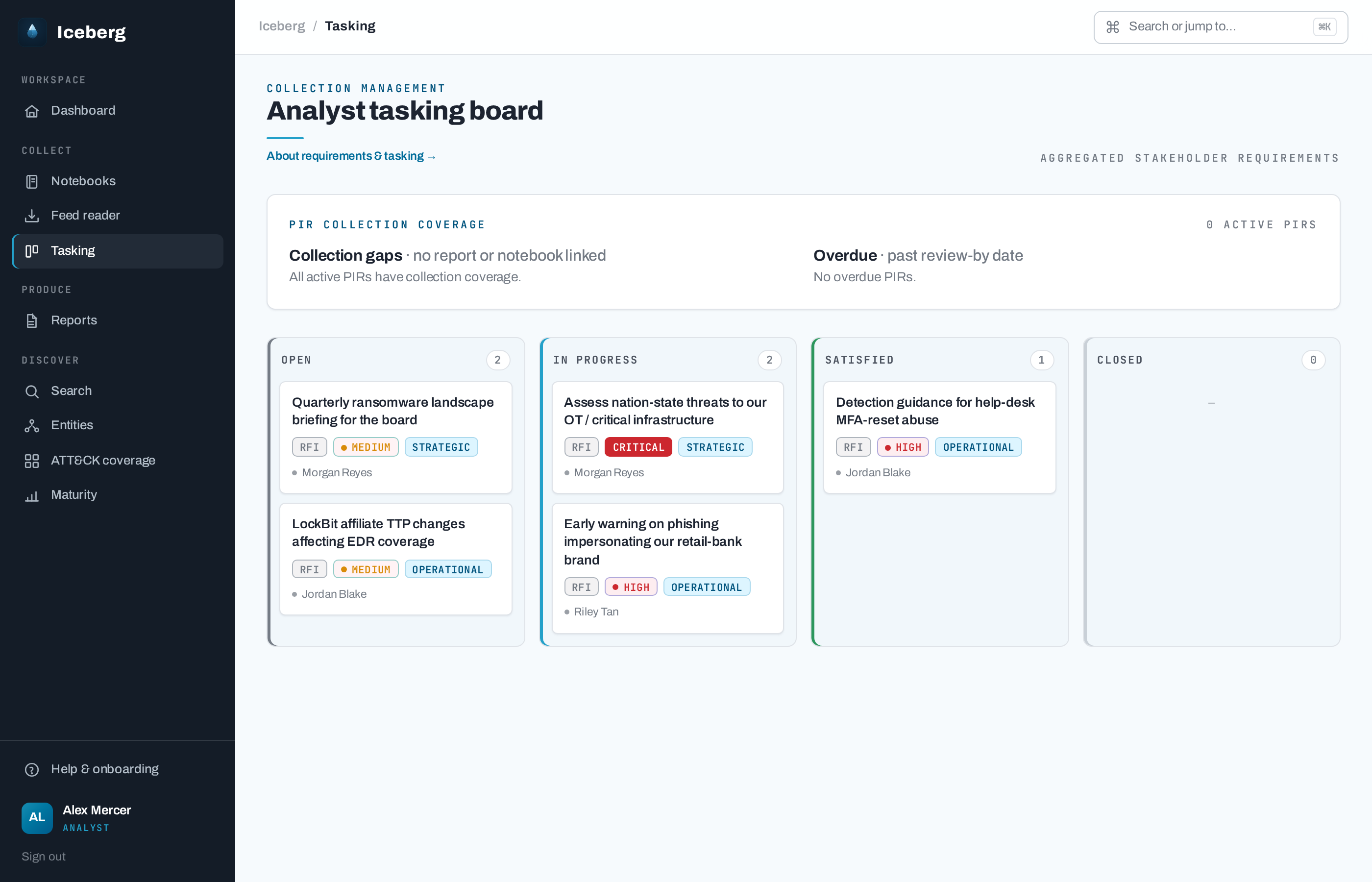
Stakeholders (read-only users) record their own intelligence requirements, typed by how they direct work:
| Type | Meaning | Shape |
|---|---|---|
| PIR | Priority intelligence requirement | Decision-tied, time-bound, carries priority |
| GIR | General intelligence requirement | Standing collection interest |
| RFI | Request for information | Ad-hoc question, satisfied by a specific product |
Requirements aggregate into a tasking board grouped by status. Ordering blends urgency and kind — a PIR is floored to at least High priority so it leads standing work, but a genuine Critical item still tops its column. A PIR coverage panel flags PIRs with no linked report or notebook (collection gaps) and those past their review-by date.
Collection: notebooks
Analysts open a topic notebook and gather material into it:
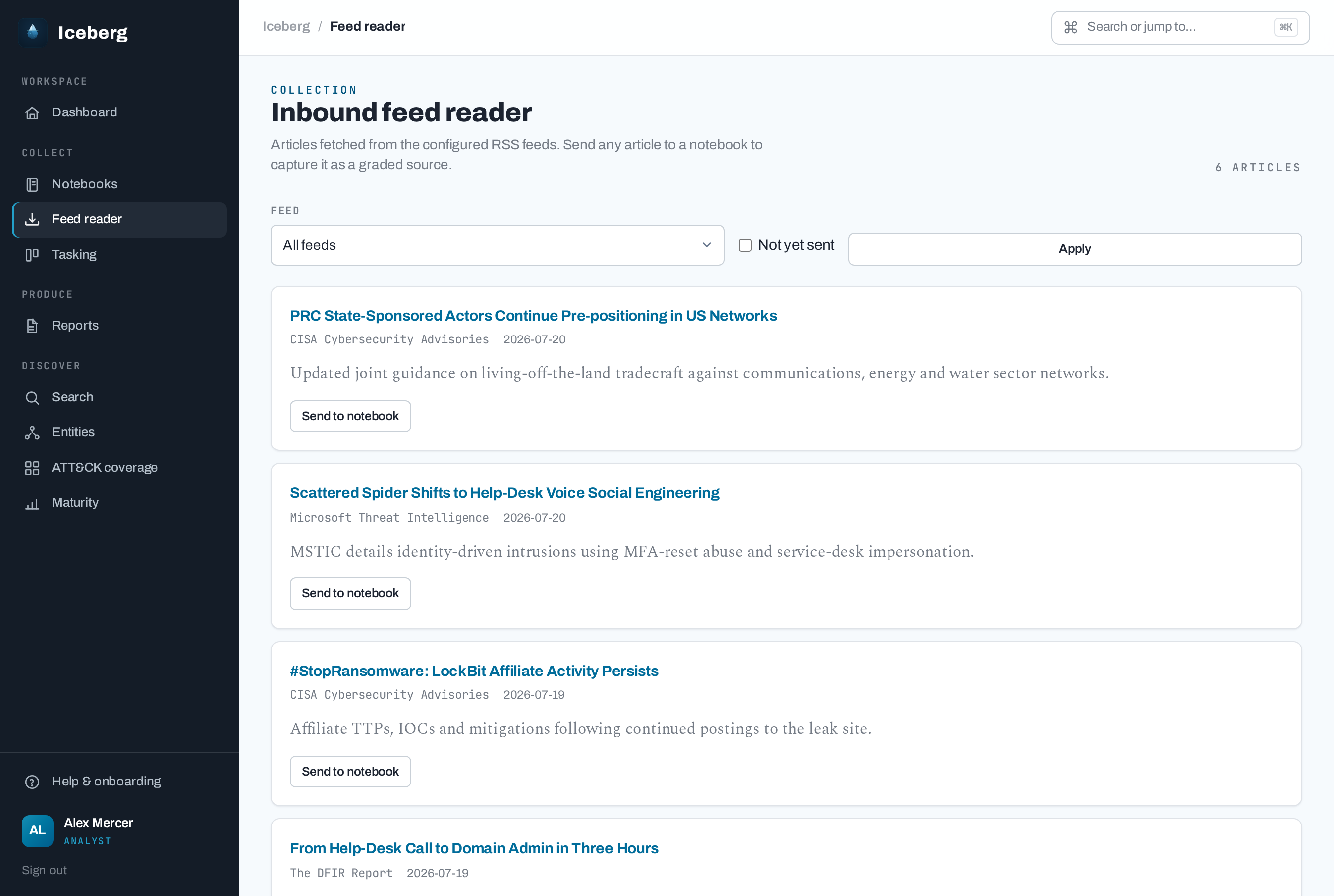
- Sources — links and references, graded with an offline Admiralty/NATO reliability heuristic; manual sources default to TLP:AMBER.
- Notes — free-form analyst notes.
- Attachments — uploaded reference files (MIME-whitelisted, size-capped, magic-byte validated).
- Light-touch IOCs — indicators staged as notebook entities for later citation and MISP push. Iceberg is not an IOC store; the authoritative store stays external.
Collection is fed from outside too: an admin-configured RSS/Atom reader lets analysts send an article to a notebook as an auto-graded source, and writers can pull from TAXII 2.1 and MISP servers directly into notebook sources and IOCs.
Analysis: structured techniques
Inside a notebook, analysts apply structured analytic techniques whose artefacts embed live into reports:
- Diamond Model of intrusion analysis diagrams
- Analysis of Competing Hypotheses (ACH) matrices
- Figures — uploaded images with captions
Inline-embed tokens ([[diamond:ID]], [[ach:ID]], [[figure:ID]], and a
bare [[attack]] coverage matrix) resolve in the live preview, the published
web view, and the PDF. Tokens are notebook-scoped — a cross-notebook or
unknown id degrades to an "unavailable" notice rather than leaking content.
Production: authoring and review
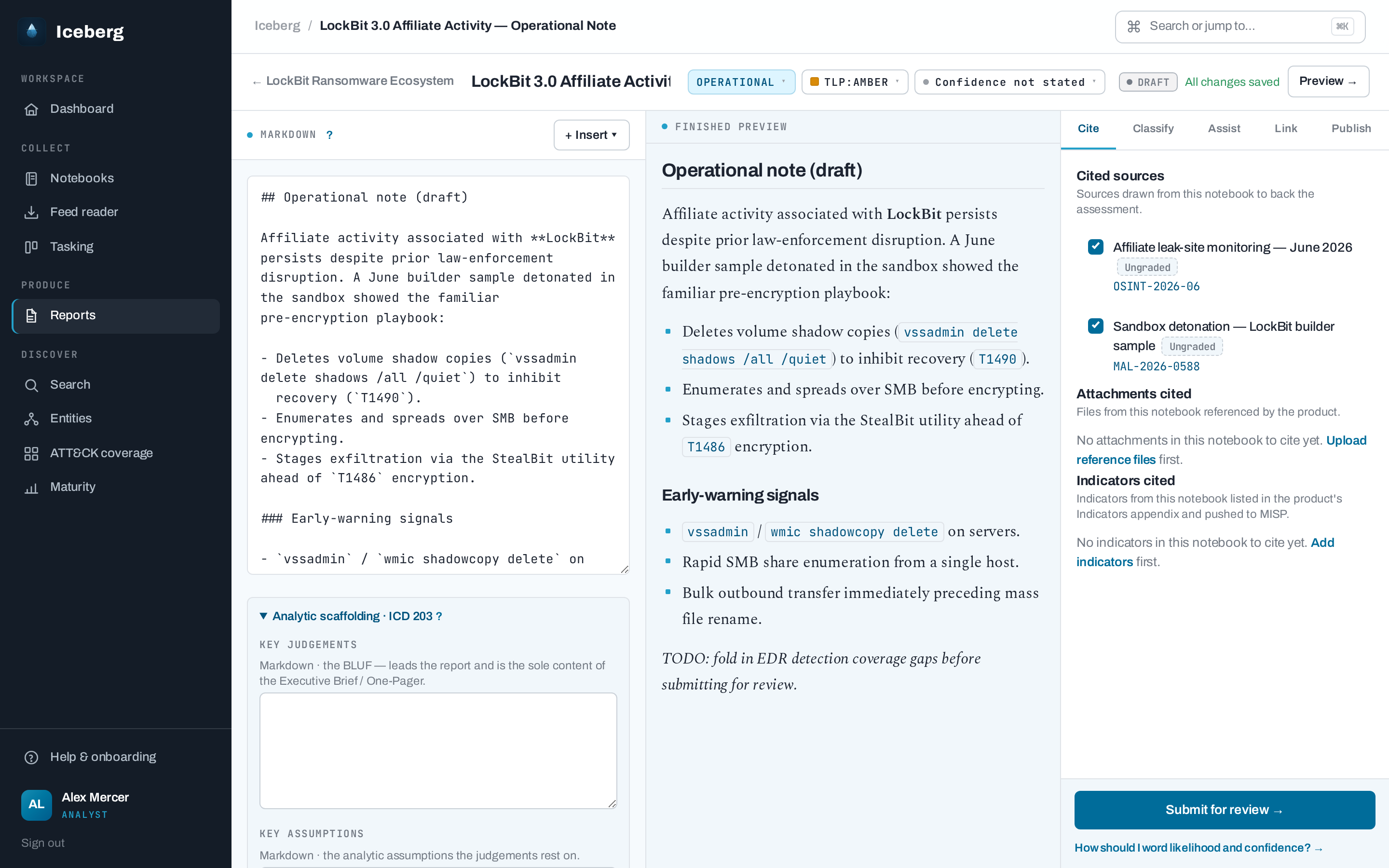
One or more reports (intelligence products) are authored from a notebook's material in a full-height three-pane editor: markdown, live preview, and a docked panel for citations, tags, requirement links, and rendering.
Reports carry:
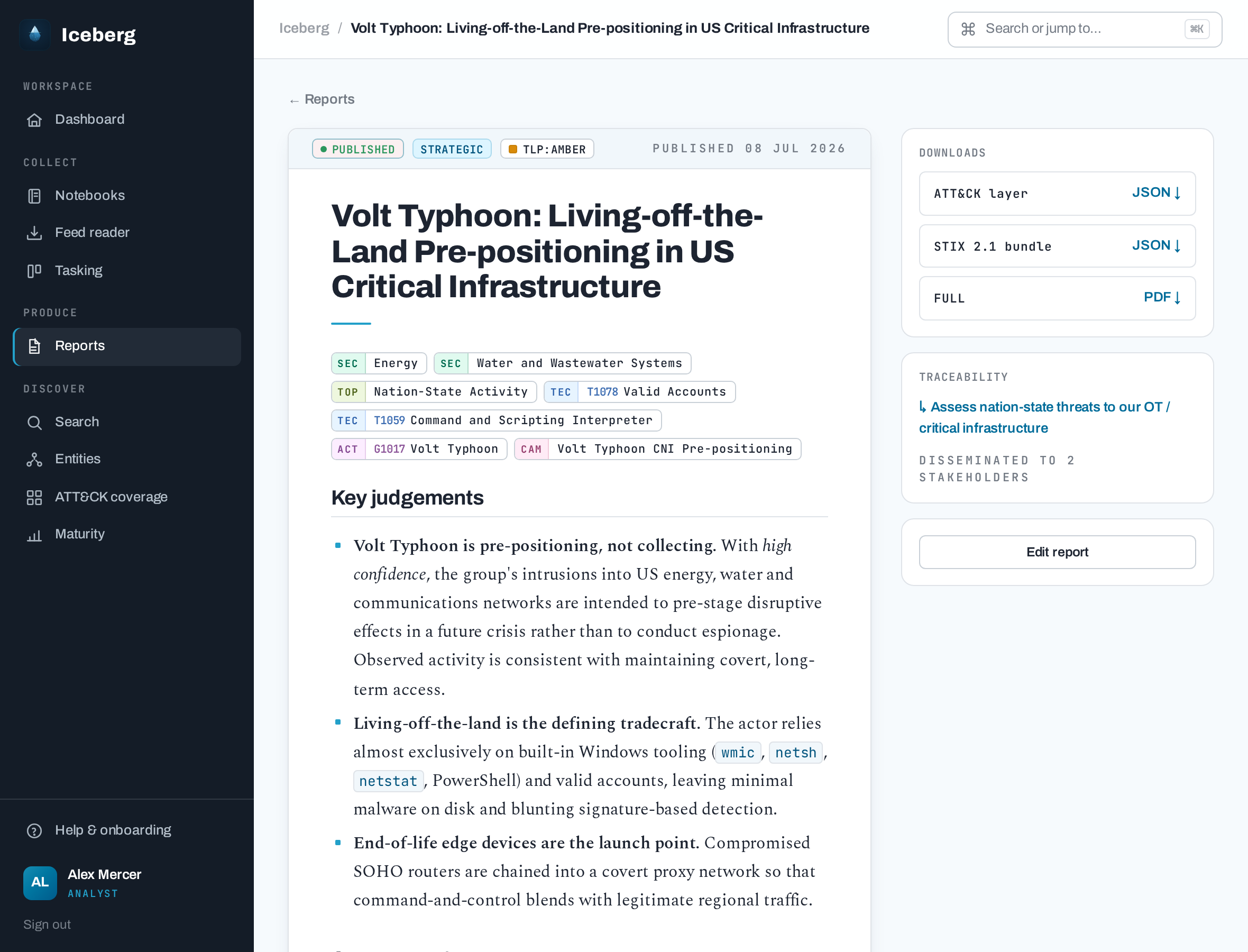
- an intelligence level — Strategic, Tactical, or Operational — used for dissemination matching;
- a TLP marking — a display and routing marking, never an in-portal read gate;
- citations of notebook sources and attachments, rendered as numbered references;
- cited indicators, rendered as an Indicators appendix;
- taxonomy tags — threat actor, campaign, malware, ATT&CK technique, sector, topic — driving faceted search, entity profiles, and an ATT&CK coverage heatmap;
- an advisory estimative-language lint (tradecraft nudges, never a block).
Products render on demand to branded PDFs via Typst in three formats — full assessment, executive brief, one-pager — independent of intel level.
Reports move Draft → In review → Approved → Published. Publishing freezes an immutable publication snapshot: stakeholder views, PDFs and MISP pushes all serve from the snapshot, never from live notebook material.
Dissemination: the stakeholder feed
On publish, a report is matched to stakeholders by their preferred intelligence level and TLP ceiling and delivered to a personal feed, with optional email notification and tag-subscription webhooks. Each feed item explains why it was delivered — an answered RFI and a preference match are reported separately.
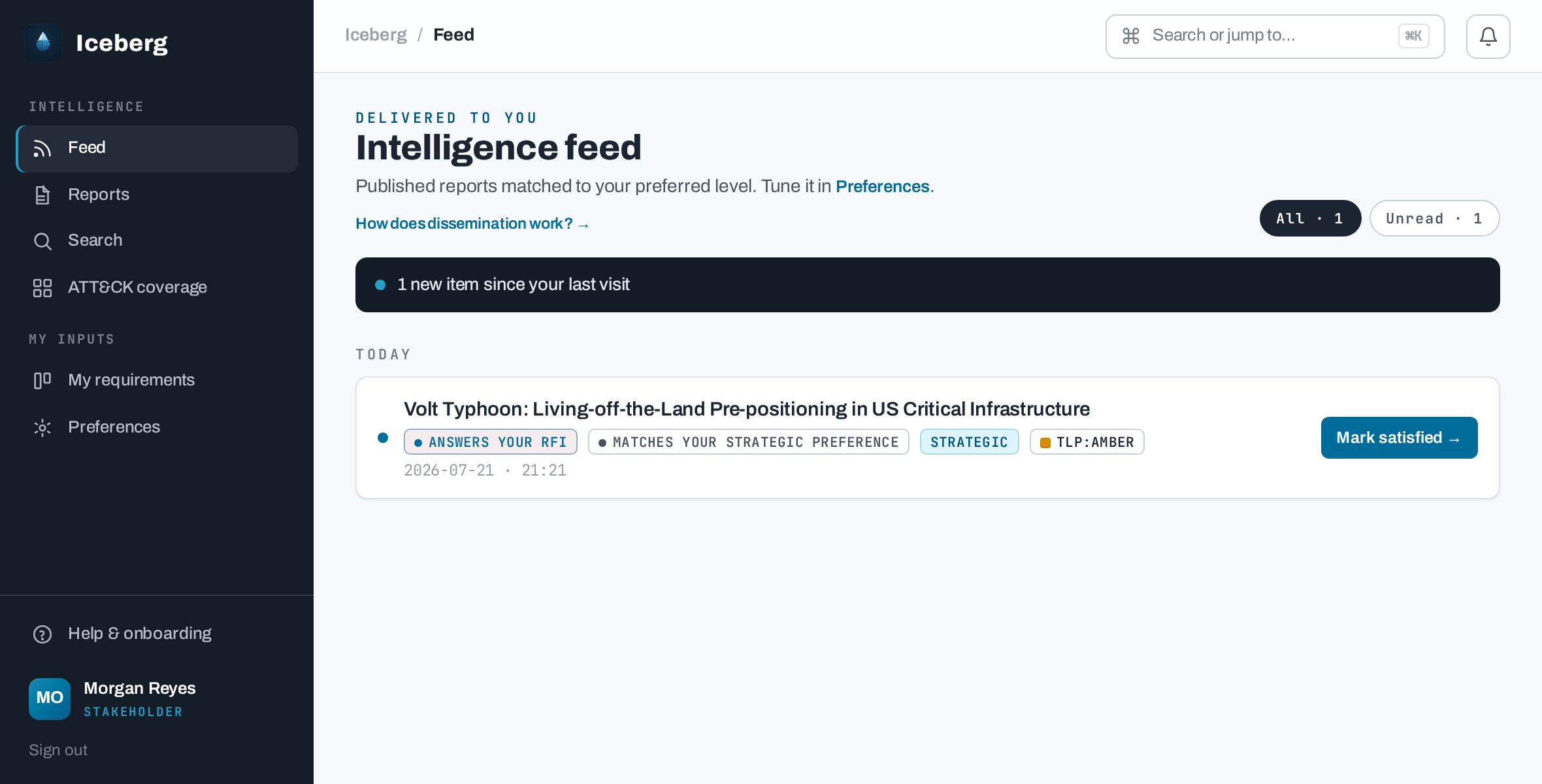
Feedback: closing the loop
On a delivered product, a stakeholder leaves feedback: a usefulness rating, an optional RFI-satisfaction verdict against one of their own requirements, and a comment. A Met verdict from the owning stakeholder auto-advances that requirement to Satisfied — closing the cycle. Feedback surfaces on the report for authors and on the requirement for analysts, and rolls up into a writer-only program maturity dashboard of CTI-CMM-style health indicators.